
Something New Is Taking Shape in Our Classrooms
Dear Rockridge Families and Friends,
I wanted to share something that has been bringing great energy and excitement to our school over the past weeks.
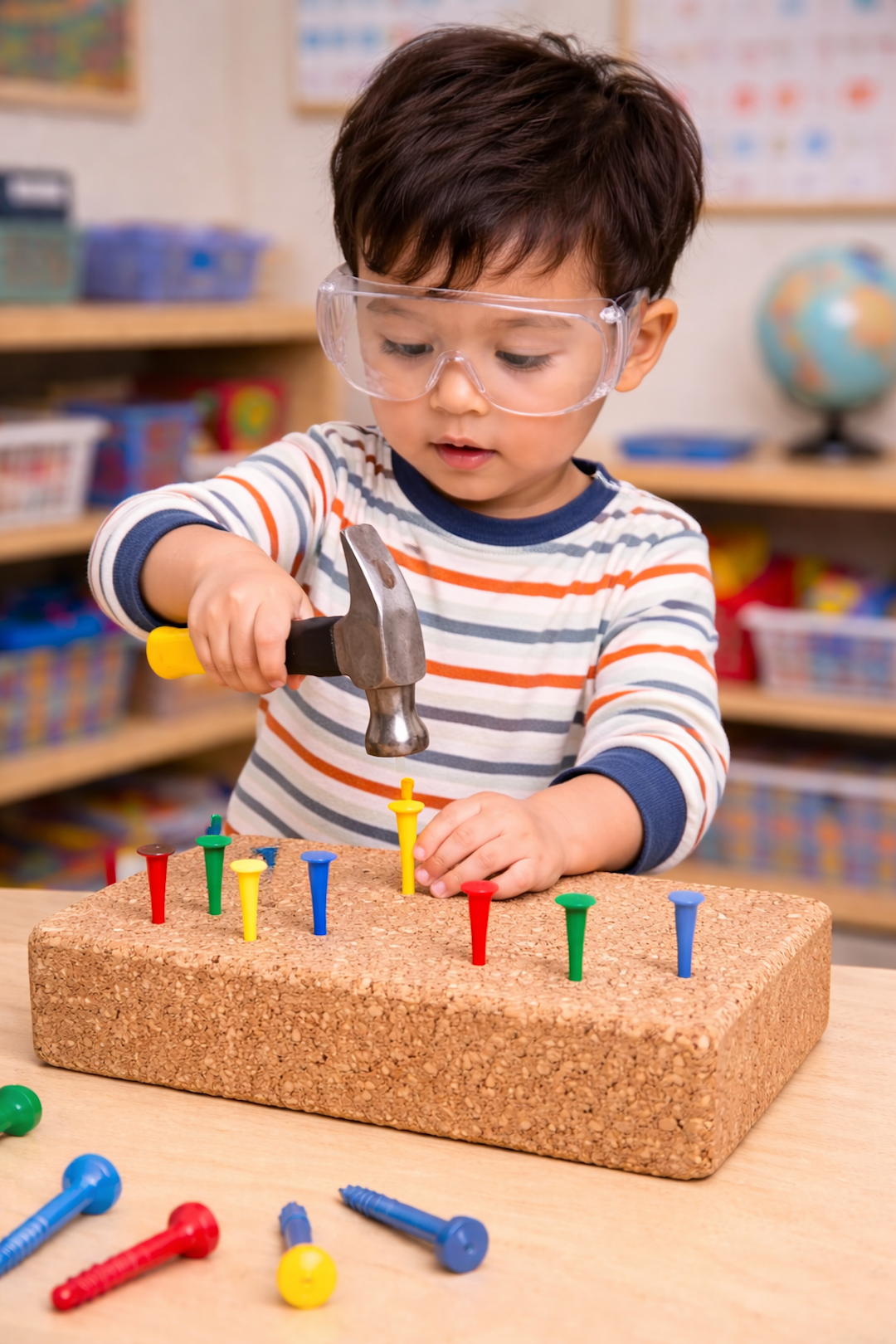
We are rolling out a new carpentry program for our students, and watching children engage with it for the first time has reminded me of why we do this work.
A child holding a small hammer, carefully tapping a nail into a piece of wood, is doing far more than building a simple object. She is measuring, estimating, and adjusting. She is testing a hypothesis — will this hold? — and revising her approach when it doesn’t. She is thinking like a scientist and working like an engineer, and she is doing it with complete absorption and genuine joy.
This program grows directly from Montessori principles, and it reflects something we understand deeply about how children develop the thinking skills that will matter most in their lives: the earlier children encounter real problems with real materials, the stronger the foundation they build for everything that follows.
The STEM Connection
When we talk about STEM education — science, technology, engineering, and mathematics — we often picture older students, computer screens, and formal instruction. But the research tells a different story. The cognitive habits that make a child a strong mathematical thinker, a curious scientist, or a creative engineer are laid down early, in the hands and the body, long before they appear in any classroom exercise.
Carpentry is one of the richest environments we know for building those habits.
When a child measures a piece of wood, she is working with length, proportion, and spatial reasoning — the foundations of mathematical thinking. When she selects the right tool for a task, she is reasoning about function, material properties, and cause and effect. When a joint doesn’t hold and she considers why, she is doing genuine scientific thinking: observing, inferring, and testing a revised approach. When she imagines a finished object, plans the steps to get there, and adjusts that plan as the work unfolds, she is practicing the engineering design process in its most natural and authentic form.
These are not simplified or pretend versions of STEM thinking. They are the real thing, encountered at exactly the right moment in a child’s development.
What Your Child Gains
Concentration is the foundation on which everything else rests. The careful alignment of a nail, the steady rhythm of a hammer, the close attention required to follow the grain of the wood — these invite a depth of focus that is increasingly rare in modern childhood, and that transfers powerfully to every kind of learning that follows.
Physical precision develops alongside mental precision. Carpentry refines fine motor skills and hand-eye coordination in ways few activities can match. Children learn that small adjustments matter, that accuracy is built through attention, and that the relationship between thought and action is immediate and real.
Problem-solving confidence grows with every project. There is a meaningful difference between a child who has been told she is capable and a child who has built something with her own hands and knows it from the inside. That kind of confidence is durable. It doesn’t depend on reassurance.
Resilience follows naturally from working with real materials. Wood splits. Nails bend. Designs need to be reconsidered. Carpentry teaches children to treat a setback as information rather than failure — one of the most important dispositions a young learner can develop, and one that no worksheet can teach.
What About Safety?
This is usually the first question parents ask, and it is exactly the right one.
In a well-prepared Montessori environment, safety is not achieved by removing challenge, but by managing it thoughtfully. Children are carefully introduced to each tool before they use it. They learn to handle materials with precision. They are guided and supervised in ways appropriate to their age and stage, and they work with tools sized for their developmental level.
What tends to surprise parents is what happens next. When children are trusted with real tools and held to clear expectations, they become more careful, not less. The weight of real responsibility is, paradoxically, steadying. What looks risky at first glance often becomes one of the most focused and regulated experiences in the entire classroom.
A Foundation for the Future
The skills most valued in science, technology, engineering, and mathematics — the ability to think spatially, reason through problems, persist through difficulty, and bring an imagined thing into reality — do not begin in a high school lab or a college engineering course. They begin here, in the hands of a young child who is trying to build something real.
This program reflects a commitment we hold deeply as a school: to give children not just knowledge, but capacity. Not just instruction, but genuine experience.
Years from now, your child may not remember a particular lesson or a page from a workbook. But she will remember the first time she measured, planned, built, and held the finished thing in her hands. And that memory will carry with it something more important than a skill: the understanding that she can take a problem apart, work through it, and make something new.
That understanding is where every great scientist, engineer, and thinker begins.
I would love to hear your thoughts, and I am happy to answer any questions you may have. Please feel free to reach out.
Warmly,
Sandi Zorinich
Head of School
Recent Comments