
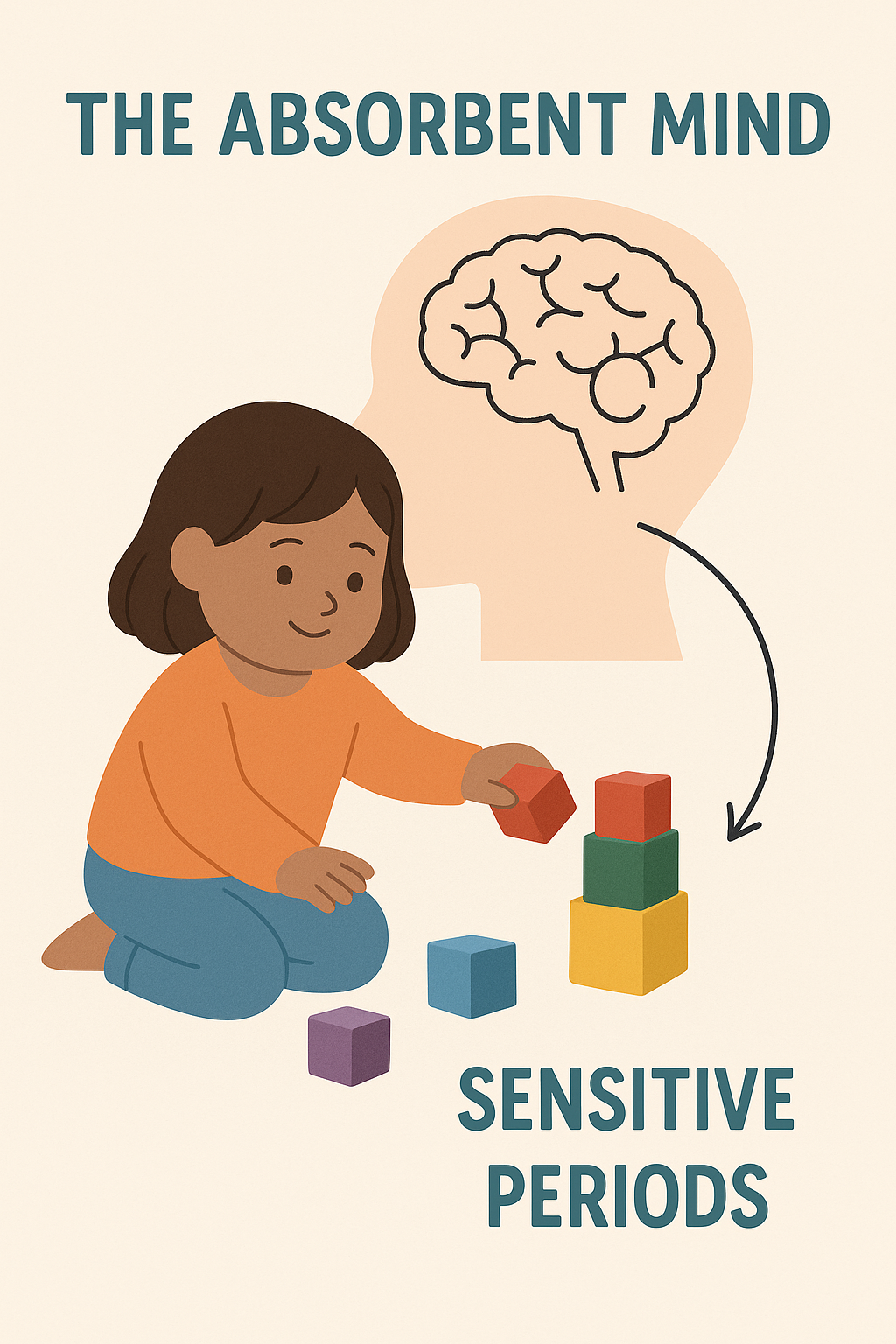
One of the most fascinating and vital concepts in Montessori education is the understanding of how children learn in their early years — specifically, through what Dr. Maria Montessori termed the Absorbent Mind and Sensitive Periods.
If you’ve ever watched your child eagerly repeat a task — like pouring water over and over or asking you to read the same book nightly — you’ve witnessed these phenomena in action. Understanding the Absorbent Mind and Sensitive Periods not only sheds light on your child’s development but also helps you respond in ways that deeply support their growth.
Let’s explore these two intertwined ideas, what they mean for your child, and how you can nurture them at home.
What is the Absorbent Mind?
Dr. Maria Montessori coined the term Absorbent Mind to describe the unique, sponge-like capacity of children from birth to age 6 to absorb knowledge, behaviors, and experiences directly from their environment without conscious effort.
In these early years, children aren’t learning in the way adults do — by studying, memorizing, or rehearsing. Instead, they are unconsciously and effortlessly taking in everything around them: language, movement, culture, social norms, even the emotional climate of their home.
Dr. Montessori wrote:
“The child absorbs these impressions not with his mind but with his life itself.”
There are two phases of the Absorbent Mind:
-
Unconscious Absorbent Mind (Birth to ~3 years): The child is passively soaking up everything in their environment. This is when language, motor coordination, and emotional impressions are internalized rapidly and deeply.
-
Conscious Absorbent Mind (~3 to 6 years): The child begins to actively seek experiences and deliberately repeat activities to master skills. Curiosity drives exploration and refinement.
Understanding this helps explain why the early years are so critical — and why Montessori environments, including your home, play such an important role.
What Are Sensitive Periods?
Within the broad landscape of the Absorbent Mind are specific Sensitive Periods — unique windows of time when the child is especially attuned to learning particular skills. During these periods, children display intense interest, attention, and capacity for mastery in certain areas.
Once a Sensitive Period passes, the same learning can still occur, but it will require more effort and may lack the same natural enthusiasm.
The Key Sensitive Periods and Their Age Ranges
|
Sensitive Period |
Approximate Age Range |
What the Child is Drawn To |
|
Order |
Birth to ~3 years |
Consistency, routines, organization of environment |
|
Language |
Birth to ~6 years |
Listening, speaking, expanding vocabulary, sounds, and writing |
|
Movement (Gross & Fine) |
Birth to ~4.5 years |
Control of body, coordination, manipulating objects |
|
Refinement of the Senses |
~2 to 6 years |
Discriminating sound, texture, color, shape, smell |
|
Small Objects |
~1.5 to 4 years |
Fascination with tiny details and objects |
|
Social Behavior/Grace & Courtesy |
~2.5 to 6 years |
Learning manners, social norms, empathy |
Each period is characterized by focus, persistence, and joy in repeating related activities. For example, a child in the Sensitive Period for order might become upset if their toys are rearranged unexpectedly — not because they are fussy, but because their developing mind is constructing an internal sense of order.
How This Plays Out in Montessori Classrooms
At Rockridge Montessori, our guides are trained to observe and respond to these Sensitive Periods with the right materials and activities at the right time.
For instance:
-
A child showing keen interest in sounds might be introduced to Sound Cylinders to refine auditory discrimination.
-
A child in the Sensitive Period for language is offered Sandpaper Letters and storytelling to enrich vocabulary and phonetic awareness.
-
Children refining movement are guided toward Practical Life activities like spooning, pouring, and using tongs.
The environment is curated to meet these developmental windows, ensuring children experience deep, joyful learning.
Supporting the Absorbent Mind and Sensitive Periods at Home
You don’t need specialized materials to support these developmental phases — though some Montessori-inspired tools can be helpful. Here’s how you can nurture your child’s sensitive periods in daily life:
1. Sensitive Period for Order
-
Create consistent routines — morning rituals, meals, and bedtime at predictable times.
-
Keep belongings in specific places — have a basket for shoes, a hook for jackets.
-
Involve your child in organizing — sorting laundry, matching socks, setting the table.
Resource Tip: Read Simplicity Parenting by Kim John Payne, which offers guidance on creating order and rhythm in family life.
2. Sensitive Period for Language
-
Read aloud daily — books like Brown Bear, Brown Bear, What Do You See? build vocabulary with rhythm and repetition.
-
Speak clearly and in rich language, even to toddlers — avoid “baby talk.”
-
Sing songs and play rhyming games — these enhance phonemic awareness, critical for reading readiness.
Suggested Resource: The Read-Aloud Handbook by Jim Trelease for age-appropriate book recommendations.
3. Sensitive Period for Movement
-
Provide plenty of gross motor opportunities: climbing at playgrounds, dancing, obstacle courses.
-
For fine motor skills: activities like threading beads, using tweezers, or manipulating playdough.
Toy Suggestions:
-
Grapat Wooden Toys — open-ended materials great for sorting and fine motor work.
-
Hape Wooden Lacing Beads — for threading and coordination.
4. Sensitive Period for Refinement of the Senses
-
Nature walks: Encourage your child to observe textures, smells, and sounds.
-
Cooking: Let them feel different textures — flour, grains, vegetables — and smell herbs and spices.
At-Home Tool: Montessori Sensorial Kits from Montessori ‘N’ Such or Monti Kids, which include materials designed for sensorial exploration.
5. Sensitive Period for Small Objects
-
Create sorting activities with buttons, coins (under supervision), or tiny figurines.
-
Puzzles with small pieces can captivate a child during this phase.
Book Recommendation: The Joyful Child: Montessori, Global Wisdom for Birth to Three by Susan Mayclin Stephenson — a guide to creating activities for young children.
6. Sensitive Period for Social Behavior
-
Model polite behavior: saying “please” and “thank you.”
-
Teach turn-taking and sharing through board games or collaborative play.
-
Practice greetings, introductions, and apologies — reinforcing respect and empathy.
Activity Tip: Hosting family meals or playdates where children practice introductions, passing food, and saying thank you cultivates grace and courtesy.
Observation: The Key to Supporting Sensitive Periods
Dr. Montessori emphasized the importance of observation. At home, take time to watch your child play and explore:
-
What tasks do they repeat?
-
What objects capture their attention?
-
Are they sensitive to changes in routine or environment?
Your observations will help you offer the right experiences at the right time.
Reflection Questions for Parents
-
Have I noticed my child repeating certain actions or showing fascination with specific tasks?
-
Is my home environment prepared to allow my child to explore these interests freely?
-
How can I enrich my child’s day with more opportunities aligned with their sensitive period?
Recommended Reading and Resources
-
The Absorbent Mind by Maria Montessori — foundational reading for understanding this critical phase.
-
The Montessori Toddler by Simone Davies — a practical guide for parents of toddlers.
-
Montessori Services (montessoriservices.com) — offers child-sized tools for Practical Life at home.
-
Lovevery Play Kits — curated, age-appropriate toys based on developmental windows.
In Closing
Your child’s mind is not just learning — it is building who they will become. The Absorbent Mind and Sensitive Periods are nature’s way of ensuring children acquire the skills, knowledge, and attitudes they need to thrive — with joy and ease.
By observing and supporting these phases, both at Rockridge Montessori and at home, we can provide an enriching, respectful path that honors the wonder of childhood.
If you’d like guidance on recognizing your child’s current sensitive periods or suggestions for activities, please reach out to your child’s guide. Together, we can make the most of these precious, fleeting years.
Warmly,
The Rockridge Montessori Team
Recent Comments